Unknown's avatar

Namaste

5255_1186850025794_3591488_n

Room with a view

India exists in several centuries simultaneously. These 2 pictures epitomize the stark reality. They were both clicked in the very heart of urban India. Not in some remote, dusty outback as one might imagine

The first belongs to Mumbai, the commercial hub of the country. Standing on my balcony & sipping a morning cup of tea this is what I espied – an elephant go majestically by.

9132_1215057050952_3686076_n

Rush hour traffic

Dashing to work, in the national capital Delhi, and what have you? A traffic jam revolving around a pachyderm, camel, bus & a car.  All merrily blocking the way.

This is co existence.

Laugh as you may, it is also beauty in chaos. Hardly to be noticed or commented upon. An everyday thing that we take in our stride.

Unknown's avatar

A State of Collapse


When the rest of India was agonizing over a horrendous incident of gang rape in the national capital there was I in another metro, cruising the streets at night, alone & unafraid. That is Calcutta. Sorry folks. I cannot call it Kolkata. It sticks in the throat as does Mumbai, Bengaluru & Chennai.

As always pictures speak louder than words.  India is witnessing a minor economic miracle of sorts but West Bengal continues in deep slumber. It was pretty awful even during my last visit five years ago but the level of squalor & dilapidation is now completely overwhelming & is to be seen to be believed. It is as if the city were drugged into a stupor.

The much-hyped Millennium Park near Babu Ghat resembles a locality park in any other town. One can take a ferry to Howrah from here. The swank SBI building over looks hovels & slums. But Rabindra Sangeet is everywhere, in the most unlikely of places, as if it were the panacea to all the city’s ills. Seeing some happy frolicking street kids I took out the camera to capture the moment. After all where else in the world would one get to see such happy, care free children. Their parents the very dreg of society. “ Eh Didi,” said a voice from inside the flaps of a hole in the ground, “ photo nai lena…. No pictures… yes, not even of the children…. Only if you pay for their milk “

A poor old Anglo Indian lady sits crumpled & alone at the Park Street – Ghalib Road corner inviting stares from every passer by. Catching my eye she whispers ‘ can you help me cross the street, please’? Just like that. I try to help her get up ‘ I need some food’ she says. Next to us are Barista & Café Coffee Day outlets. ‘ What would you like to eat,’ I ask. ‘Some food.’ I leave her sitting in the corner & return with a chicken & cheese sandwich. And why not? What the hell!  Then hand in hand Suzie & I cross the road together to go our own separate ways.

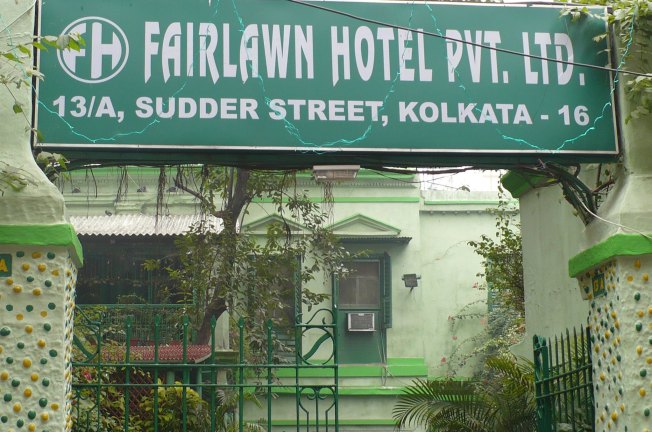
The Hotel Fairlawn on Sudder St is a delightful place as is its owner, 92-year-old Violet Smith, an Armenian who has lived all her life in this country. Her face is creased with smiles as she greets & waves goodbye to her many guests who are all welcomed with an old world warmth & cheer.

The Fairlawn is a 2 star property having just 18 rooms. The building is around 240 year old but has been with the family for about 80 years now. It gives the feel of a home away from home & home it is to the many who come again & again from all corners of the globe.

So, Calcutta is in a state of irreparable decay. Lenin’s’ own country, now governed by a mad woman, all squalid & run down. What could one hope for or expect?

There was an art exhibition happening at the Oxford bookshop followed by cakes & ale & a lot of the paintings depicted empowered women astride what looked like emaciated tigers. But what of it? This simply whittles the issue down.

Coming out for a whiff of fresh air there are long serpentine queues outside the Indian museum. Now in which other city in India could one see anything remotely like that?

And what is that in that corner, with so many curious hangers on?

That is a fellow peddling his ware – a collection of priceless old stamps. And coins.  Calcutta surely has many firsts.

December 2012

P1020179

Footpath,old coins on sale Footpath,old coins on sale
long queues outside the Indian museum long queues outside the Indian museum
hovels opposite the swank SBI building hovels opposite the swank SBI building
Hotel Fairlawn Hotel Fairlawn
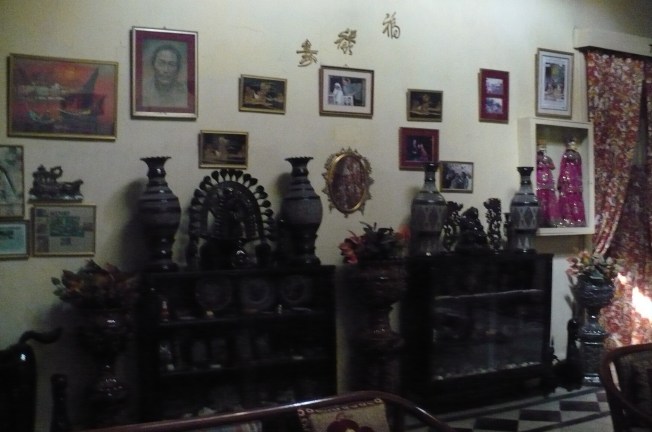
Interiors .Fairlawn Interiors .Fairlawn

P1020269

P1020268

P1020272 P1020273 P1020274 P1020275 P1020276 P1020277

P1020279

Unknown's avatar

Tariki Turkiye

Tariki Turkiye

Dateline Turkey


Come whoever you are. Just come as you are

Turkey is the sixth most popular tourist destination in the world. It is a delightful mix of East & West, modern & traditional, young & old. And nothing epitomizes this better than Istanbul on the Bosporus. A Eurasian city astride two continents. It is a place of frenetic activity & leisurely pace. One feels the vibrant energy & sense of joie de vivre everywhere. It’s many charms ever so beguiling.  Turkey’s largest city. Let these pictures do the talking.
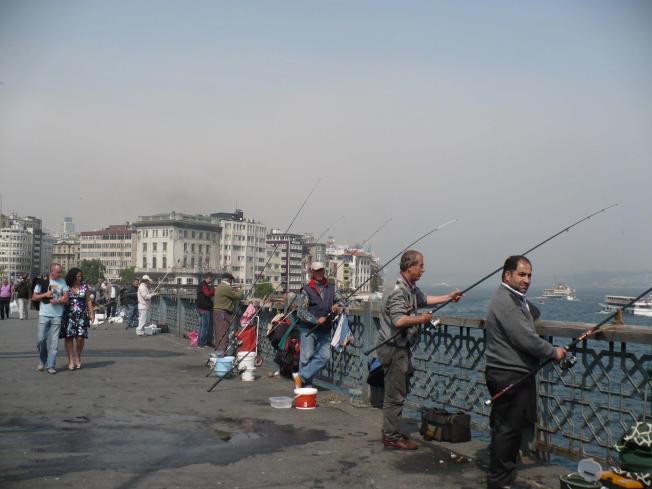
Its leisure time always

Foreign language students

English is spoken & understood in very few of the cities & towns of Turkey. To that extent communication does pose a problem.  At Cannakale I asked  a group of women  for directions to the jetty. I knew it was in the general vicinity but did not want to waste time going around in circles. The women spoke no English whatsoever. ‘ Just a little ’ gestured one & then they animatedly broke into what seemed  a torrent of gibberish. Except that it was Turkish, not gibberish. ‘Wait’, I yelled, halting them in the tracks. I just heard you say ‘ishaara’. I understand that. I am from Hindustan. I understand ‘ishaara’. There were smiles all around as they followed me on to the road pointing the way to the jetty. Using sign language or ishaara. ‘Shukran’, I said. Thank you, followed by a wave of the hand & ‘gule gule’.  Goodbye!

Experts believe that the Indo European group of modern languages originated in Anatolia, Turkey. This would of course include English, Turkish & Hindustani. Mr. Burak Akcapar, who is presently the Turkish ambassador in New Delhi has said that Turki & Hindustani have at least 9000 words in common. You bet they do, as I discovered trying to make myself understood in No English – In – Turkland. This understanding came upon me very slowly, aheste aheste. But it made travel – sefer – so much easier especially when chatting up women (avrat /aurat).  Only (sirf) women, in some heart to soul (ruh) talk. Travelling alone this was not only useful but immensely interesting. What do women who are complete strangers (ecnebi/ajnabi) discuss? Our thoughts & feelings & the injustice done to us, obviously. Common words with the deepest meanings. Yani,- that is to say –  words such as

gam       sorrow

gurur    pride

muhabbet   love

nefret   hatred

dost  friend

dusman  enemy

musibet  trouble

masum  innocent

akil – akal   intelligence,

asik  ashique  lover,

avare awara  vagabond

azad  freedom.

This above all. Azaad. O, for a life of freedom!

The world – dunya  – appeared to shrink despite the wide chasm of the seas – darya – separating our shores – sahil.
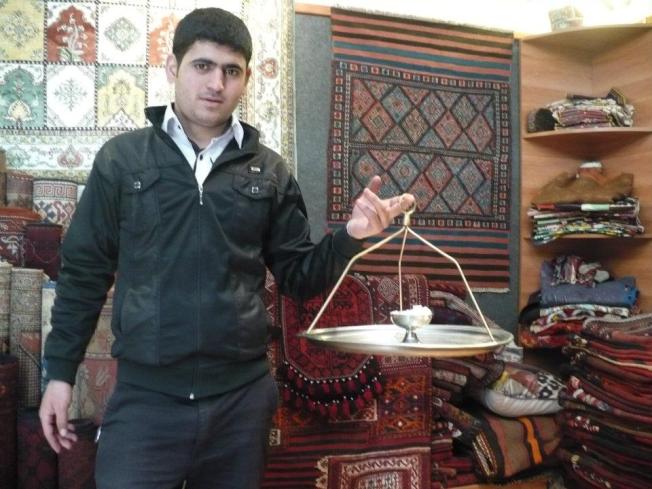
The Cay/ Chai Boy

There are a host of general words that the reader will easily comprehend. The most familiar being vatan, hamam, meydan, hisap (hisaab), faqir, insan, saf, zalim, seytan. If someone were to commit a gunah he would be taken to an adalet or to the polisi with a seykayet against him.

Many of the inns sarays are owned & managed by Kurds who are a politically disgruntled minority. Away from their families they come to the cities in search of work. A lot of them taxi drivers. One has to watch out & keep alert or else get completely rooked. It’s the same old story all over the world ‘dost‘ So look yourself in the mirror ‘aina’ before getting judgmental

The bazaars are laden with goods from all over. And the dukan has practically everything from kitap to sabun to seker, sugar or shakkar. The stalls are full of absolutely taze ananas, badem, nar, pomegranate or anar  there are cay chai shops, chaiwallahs & hamams. Away from your vatan you are a misafir here, a guest. We love you yar.

The Dervish before his performance

I had dinner one evening at Café Mesale in Sultanahmet. I had to be there by 8pm in time for a performance by a whirling dervish. A drink was ordered. Yes, sarap or sharab is readily  available in this  Islamic republic. The dervish appeared with his tombstone like headgear & white shroud & whirled with open arms, his right hand directed to the sky ready to receive the creators blessing & the left turned solidly towards the earth. He whirled & pivoted from right to left stating the fundamental belief that the human  condition is meant to revolve & circulate. Like blood for instance. It was mesmerizing.

The whirling Dervish

The food at the café had a variety of taste & traditional flavor. Baharat is the word for spices in Turkish because spices originally came from Bharat, India in Hindi. Even today the spice markets  are full of exotic spices from  Hindustan as the Turks would have it.

 When cultural vocabulary of any language creates special words to denote a special connection, we can truly say that we have entered each other’s consciousness. The same as other Hindustani words like vilayat or misr, for England & Egypt respectively.

So what shall I have to eat ? I think I’ll settle for sade/ plain tava baked bread, taze sebze/ fresh vegetables, and pehnir/cottage cheese. Kebab, Pilaf, Kiyma & Kofte. Thank you.

Is it any wonder then that the chief architect of India’s wonder of the world, the Taj Mahal, is none other than a gentleman named Isa Efendi. And you know what ? He came from Istanbul

Unknown's avatar

Hampi

Image

Hampi Karnataka India

Feb 7 – 9 2012

Hampi is a small village on the southern banks of the mighty Tungabhadra.  It is today a world heritage site, the ruins spread across 26 sq kms of what was once the glorious Vijayanagar empire (AD 1343 – 1565) It can be easily reached from Bangalore and Goa as both cities are roughly equidistant from it. Hospet, the nearest railhead is 11 kms away. There is a night train from Bangalore, the 16592 ‘Hampi Express’ that departs at 10 pm arriving at Hospet at 07.40 am. From here one could take a taxi, bus or auto.

Most visitors prefer to stay at the several hotels & lodges in Hospet for Hampi is a mere 11 kms away. They can have a quick ‘dekho’ over the weekend. ‘Been there done that’ kind of thing & slip away.  For their own selfish gains the Fat Cats have conspired with the establishment to promote it as a base for Hampi. But Hospet is definitely not for me. It is a dusty, brick & mortar town that is dull, boring, staid & characterless. Imagine the poetic beauty of Hampi juxtaposed with the ugliness of a modern Indian town. I much prefer the gentle folk of the charming countryside that the local mafia is desperately trying to browbeat into submission. In order to get the tourists to stay at their commercial properties in Hospet they are inventing all kinds of rules  & regulations to declare the village homesteads irregular & illegal.

Across the river is village Virupapar Gadde where I am going to stay. I want to go across in a Coracle, the tiny 2 seater basket that the villagers use but dare not because I cannot swim. I take the motor ferry instead. A noisy polluting affair.  It takes 2 minutes to go across. The charges being Rs 20 – Rs 15/ with – without luggage. The ferry plies everyday from 7am – 6pm & it is always tipping because it is overloaded.

Hey I CANNOT SWIM ” But who’s’ listening. This is India.

Note: Please carry minimum baggage. I had a small rucksack only. Also the short walk from the ghats to the boat is through mud & slush. I wore 2 plastic shower caps over my shoes rinsing them with a bottle of Bisleri on reaching the opposite bank.

Image

I am booked at the  ‘Shanthi Guest House’ (SGH), which is a 10 – 15 minute walk from the river point. No extra baggage remember. You have to lug it by yourself all the way. There are farms & homesteads a plenty but this village prospers & thrives on tourism. A single unpaved road runs through it  – an entire village of a few hundred families only.  It is clean, easy, uncomplicated & you never have to haggle for anything. Hope it remains unchanged, like this forever. The locals are a simple homely lot. They own the guesthouses, shops & eateries while the workers are from Nepal & Himachal mostly. The majority however are visitors from all corners of the globe. International flotsam & jetsam. No wonder cuisine from almost everywhere is readily available. That single nameless street has it all. Even the ubiquitous German bakery. Not to mention the reflexology parlor where I had a superb foot massage.

And the Israelis are everywhere. Flying their flags & occupying territories. Much like the Russians in Goa.

I have to say that the Karnataka countryside is extremely beautiful. It is lush & green with fields of paddy, sugarcane, banana & coconut palm. It is also a moonscape of giant rocks & boulders with the river meandering by. The rocks are everywhere & in all shapes & sizes. A bewildering variety that gives Hampi & its environs a unique colour.

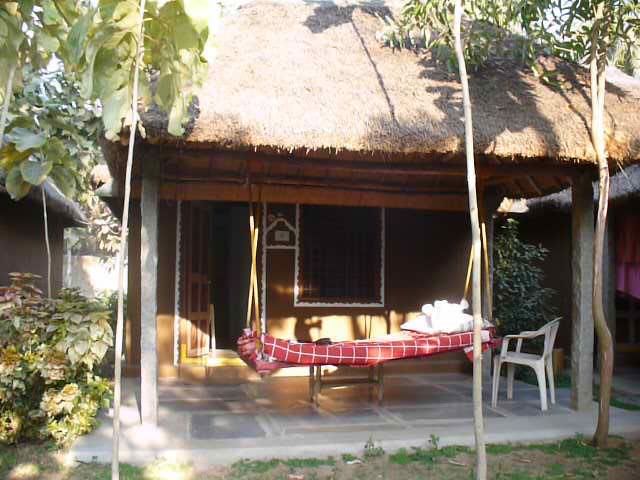
My accommodation at SGH is a thatched cottage in the midst of a small private garden. It is very basic & consists of a verandah that has a swing bed, the main room that is neat & functional & an attached toilet. All this at Rs 800 a night. (You could have a river view room for Rs 1500 instead.)  The property has several cottages, all interlinked by stone pathways. Beyond lies the green of the fields, plantations & groves & further beyond the river. The whole area is largely unfenced giving one a sense of unfettered freedom & joy.

 Loved the mosquito net hung low over the bed. Can’t remember when I had last used one.

Image

Food at the SGH restaurant is just about okay but there is ‘Gouthami’ next door  & it has excellent fare. I thought their pizza  & south Indian thali really good. After a full day of sightseeing from monuments to ruins to museum this is the place to stretch out & relax. There are candle lit low tables, floor cushions, throws  & mattresses. There is music, laughter & chatter as people exchange notes over tall glasses of beer & platters of food. There is Internet, Skype & Wi-Fi facilities & late night movies if you wish to watch. – ‘The Great Gatsby’ was playing one evening. The atmosphere relaxed & chill after a hectic day at the archaeological sites. Also one can’t help but notice that the crowd here is not the usual ragamuffin sort. These are serious young travellers who have come to a world heritage site  & who treat it with the awe & respect that it deserves.

The village has power cuts from 11am – 3pm daily. Luckily SGH has power backup. But network connection is poor so I walk down to the riverbed past the fields of paddy  & coconut palm. And the phone instantly springs to life. Down by the river the sun is beginning to set. A bright orange orb that is reflected in the ripple of the waters of the Tungabhadra. It is also a moment of quiet reflection & peace. Away from it all. Not a soul around except for the Gopurams of Virupaksha standing tall & beckoning from a distance

The ruins of Hampi can broadly be divided into the royal & the sacred. You could see it in a day or over several days & you could do it in many ways – by car, by auto, on foot, motorcycle or bicycle. Bikes are available on hire & it is great fun riding across a lush green countryside spattered with monuments & ruins of a bygone era. I once cycled 5 kms away to Anegondi village & as luck would have it met an old gentleman who was a direct descendant of Krishnadeva Raya under whom the Vijayanagar Empire reached its zenith.  Anegondi too is full of beautiful ruins. And the drive up is lovely. There are some temples & the Kishkindha resort. So named because Hampi & its surroundings are believed to be the Kishkindha of the Ramayana On the way to Anegondi lies the old Tungabhadra stone bridge which is no longer in use as the river has changed course several times & moved further away over the years. The bridge is also a protected heritage site. Peter an Austrian has chosen to live here. He has an organic farm  – ‘Peters’ Land ‘ -thereabouts.

Image

Most hotels here shut down after March when the tourist traffic declines because of the summer heat.

But the ruins? The ruins are what brought me here in the first place. The temples _  Virupaksha & Vithala, the grand Hampi bazaar, the Ramayana in stone, the Guard Quarters & Elephant Stables, the ruins of the ancient fortifications & much much more. One gets a breathtaking view of the magnificence of these  sites, from atop Matunga Hill. Twenty six  sq kms of glory to behold in its entirety. And while each & every monument is spectacular & bewitching my personal favorite is the Queens Bath. See it yourself to understand why.